Overview
Sangfor HCI (Hyper-Converged Infrastructure) brings compute, storage, networking and virtualization together into a single software-defined platform that runs on standard servers. The goal of hyperconvergence is to replace separate servers, SAN storage and network appliances with one integrated, more easily managed stack.
| Attribute | Summary |
|---|---|
| Vendor | Sangfor |
| Category | Enterprise Infrastructure |
| Deployment | On-premises (appliance or software on standard servers) |
| Licensing | Commercial (per node / host) |
| Best for | Integrated, software-defined data-centre modernisation |
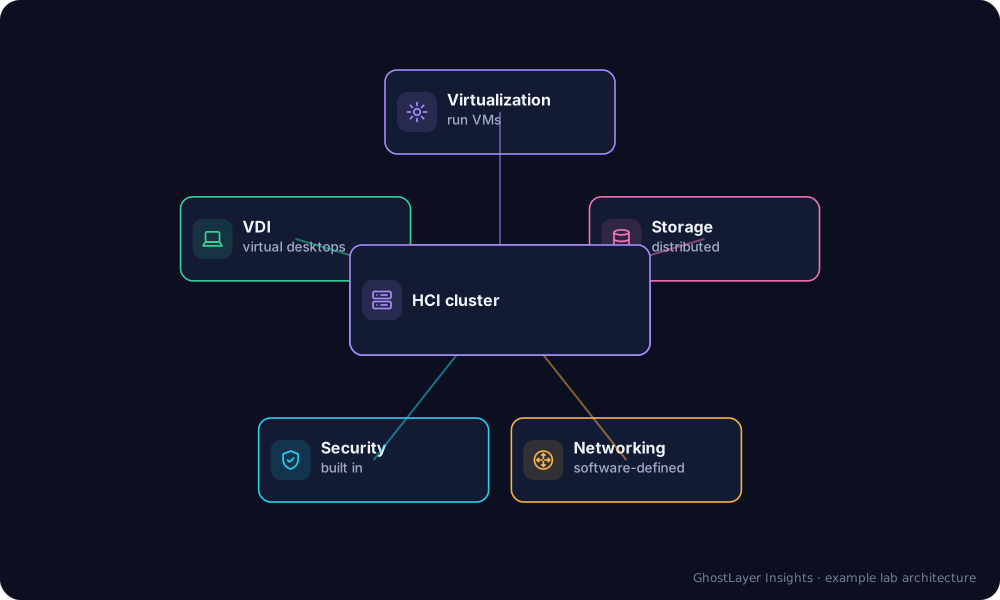
Select any component in the diagram to read what it does.
Text description of this diagram
HCI merges compute, storage, networking and virtualization into one software-defined cluster managed as a single system.
Key features
- Built-in server virtualization (hypervisor) for running virtual machines.
- Distributed software-defined storage that pools local disks across nodes.
- Software-defined networking and virtual network functions.
- Integrated security and virtual desktop (VDI) options within the platform.
- Single management console for the whole stack.
Strengths
- Consolidates compute, storage and networking, simplifying operations.
- Scales by adding nodes rather than rebuilding separate tiers.
- Often a cost-effective alternative to traditional three-tier architectures.
- Built-in resilience and disaster-recovery capabilities.
Limitations to weigh
- Ecosystem and third-party integration breadth varies by region and compared with the largest incumbents.
- Consolidating on one vendor is convenient but concentrates reliance on it.
- As with any HCI, sizing nodes correctly matters for performance and growth.
Deployment options
Sangfor HCI is deployed on-premises, either as pre-configured appliances or as software on compatible standard servers, forming a cluster that scales out as nodes are added.
Integrations
- Integrates with other Sangfor products (such as security and networking).
- Supports standard virtualization workflows and migration tooling.
- APIs and management interfaces for automation and monitoring.
Licensing
Sangfor HCI is licensed commercially, generally per node or host, with options that depend on the included modules (such as storage, networking, security and VDI). Confirm current editions and pricing with the vendor or a partner.
Ideal use cases
- Data-centre modernisation and server consolidation.
- Branch or edge sites needing a compact, self-contained stack.
- Virtual desktop infrastructure (VDI) deployments.
This is an independent editorial overview based on publicly available vendor documentation and general industry knowledge. It is a demonstration review: it is not a paid placement, a hands-on lab test, or a benchmark, and it does not assign a numeric rating. Always confirm current specifications, licensing and pricing with the vendor before making a decision.