
To defend against attackers, it helps to understand what they want. Most attacks come down to a handful of motivations.
What is it?
A motivation is the reason behind an attack. Knowing the likely motivation helps you predict who might target you and what they would go after.
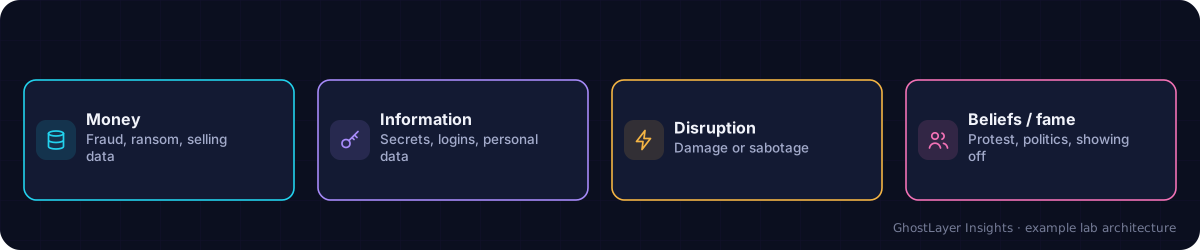
Select any component in the diagram to read what it does.
Text description of this diagram
Understanding the motive helps you understand the target and the method.
The main motivations
- Money — by far the most common. Stealing funds, data to sell, or holding files for ransom.
- Information / espionage — stealing secrets from companies or governments.
- Ideology — promoting a political or social cause (hacktivism).
- Revenge — a disgruntled employee or ex-partner causing harm.
- Challenge or fame — proving skill or earning a reputation.
Why is it important?
Different motivations lead to different targets and methods. A money-driven criminal casts a wide net for easy victims; a nation-state may spend months targeting one specific organisation. Knowing which you are likely to face shapes how much you invest in defence.
How does it work?
Most everyday attacks are opportunistic — criminals automate their tools to attack thousands of targets at once and profit from whoever is least protected. A smaller number are targeted, aimed at a specific valuable victim. Basic protections defeat almost all opportunistic attacks.
A real-world example
Ransomware gangs are motivated purely by money. They do not usually care who they hit — hospital, school, or shop. Their software spreads automatically, and they demand payment from anyone it locks. That is why even small organisations with “nothing worth stealing” still get attacked.
Check what you learned
What is the most common motivation behind cyberattacks?
Money — through theft, selling stolen data, or ransom.
What is the difference between an opportunistic and a targeted attack?
Opportunistic attacks hit many victims automatically and profit from the weakest; targeted attacks focus on one specific valuable victim.
Key takeaways
- Most attacks are driven by money.
- Other motivations include espionage, ideology, revenge, and fame.
- Most everyday attacks are opportunistic, so basic protection stops them.