
Attackers reuse a small set of reliable techniques. You do not need to perform them — just recognise them, so you know what to defend against.
What is it?
A technique is a method an attacker uses to break in or cause harm. Here are the ones you will meet again and again in this course.
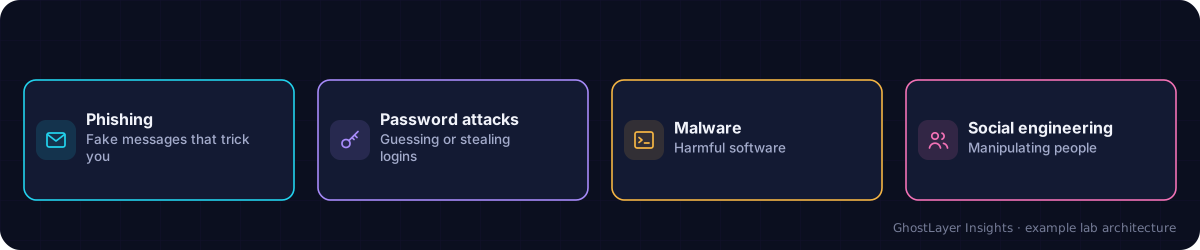
Select any component in the diagram to read what it does.
Text description of this diagram
Most attacks use a handful of well-known techniques — often tricking a person rather than breaking technology.
- Phishing — tricking people with fake messages into revealing passwords or clicking harmful links.
- Malware — harmful software that infects a device.
- Password attacks — guessing or cracking weak passwords.
- Exploiting vulnerabilities — abusing a known weakness in software.
- Social engineering — manipulating people rather than machines.
Why is it important?
Notice a pattern: several of the most common techniques target people, not technology. Attackers go for the easiest way in, and a person who can be tricked is often easier than software that is kept up to date.
How does it work?
Attacks usually combine techniques. A typical chain might be: send a phishing email → the victim enters their password on a fake page → the attacker logs in → installs malware → spreads across the network. Breaking any single link in that chain can stop the whole attack.
A real-world example
Many major breaches start with one phishing email. An employee receives a convincing message, enters their company password on a fake login page, and the attacker walks straight in using those real credentials — no advanced “hacking” required.
Check what you learned
Which common techniques target people rather than machines?
Phishing and social engineering — both manipulate people into giving access or information.
Why is breaking one link in an attack chain useful?
Attacks combine several steps; stopping any single step can prevent the whole attack from succeeding.
Key takeaways
- A few techniques (phishing, malware, password attacks, exploits, social engineering) cover most attacks.
- Many of the most successful techniques target people, not technology.
- Attacks chain techniques together — breaking one link can stop them.