
Not every attack tries to steal data. Some simply try to make a service unavailable — attacking the “A” in the CIA Triad.
What is it?
A denial-of-service (DoS) attack floods a website or service with so much traffic or so many requests that it slows to a crawl or crashes, so real users cannot get in. A distributed version (DDoS) uses many computers at once to make the flood far bigger.
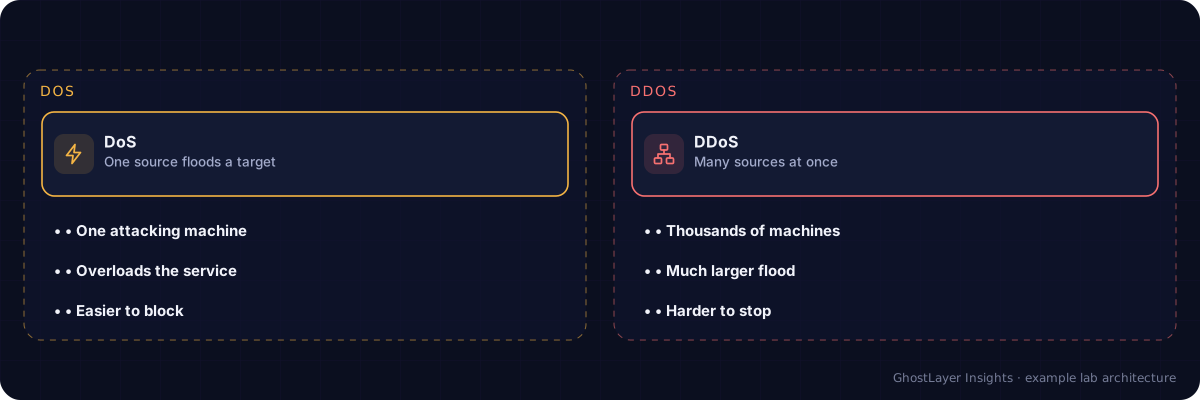
Select any component in the diagram to read what it does.
Text description of this diagram
A denial-of-service attack floods a system so real users cannot use it. DDoS uses many machines at once.
Why is it important?
For an online business, downtime means lost sales, lost trust, and sometimes a chance for attackers to cause chaos as a distraction while they do something worse elsewhere. DDoS attacks directly harm availability.
How does it work?
Imagine a shop doorway. One troublemaker blocking it is a DoS. A thousand people crammed into the doorway on purpose, so no real customer can enter, is a DDoS. Attackers often build their crowd from a botnet — a network of ordinary devices (even home routers and cameras) infected with malware and controlled remotely.
Your defence
- Specialised DDoS-protection services absorb and filter the flood.
- Keeping your own devices free of malware stops them being drafted into a botnet.
A real-world example
In 2016, a huge DDoS attack from a botnet of hacked home devices (cameras and routers) took down a key internet service, making major sites like Twitter and Netflix unreachable for hours. Many of the devices in the botnet belonged to ordinary people who never knew they were part of it.
Check what you learned
What is the goal of a denial-of-service attack?
To make a service unavailable by overwhelming it, so real users cannot access it.
What is the difference between DoS and DDoS?
DoS comes from one source; DDoS is distributed — it uses many computers (often a botnet) at once for a far bigger flood.
Key takeaways
- DoS and DDoS attacks overwhelm a service to knock it offline.
- DDoS uses many machines at once, often a botnet of infected devices.
- They attack availability; keeping your own devices clean helps everyone.