
You hear the phrase “data breach” in the news constantly. Here is what it really means and why it affects you even when it is someone else’s company.
What is it?
A data breach is when confidential information is accessed, stolen, or exposed by someone who should not have it. It could be passwords, credit-card numbers, health records, or private messages.
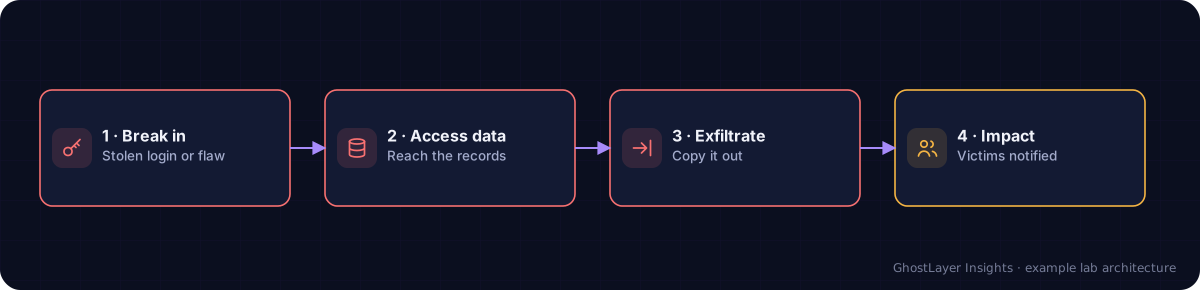
Select any component in the diagram to read what it does.
Text description of this diagram
A data breach is when protected information is seen or taken by someone who should not have it.
Why is it important?
Breaches are the point where many other attacks pay off. The leaked data then fuels further crime: credential stuffing (from the password lesson), identity theft, and targeted phishing. A breach at a company you use can put your accounts at risk.
How does it work?
Breaches happen through the very threats in this module — phishing, malware, weak passwords, or a misconfigured system left open to the internet. Once attackers reach the data, they copy it out, and it often ends up for sale online.
What to do if you are affected
- Change the password on the breached account immediately.
- Change it anywhere else you reused the same password.
- Turn on multi-factor authentication.
- Watch for phishing that uses your leaked details to seem convincing.
You can check whether your email has appeared in known breaches using a reputable service such as Have I Been Pwned.
A real-world example
A large company is breached and millions of email-and-password pairs are leaked. Months later, customers who reused those passwords find their other accounts — shopping, email, even banking — being accessed. The breach was the company’s; the knock-on harm landed on individuals who reused passwords.
Check what you learned
What is a data breach?
When confidential information is accessed, stolen, or exposed by someone who should not have it.
Why does a breach at one company put your other accounts at risk?
Leaked passwords are reused by attackers on other sites (credential stuffing), so reused passwords let one breach spread to your other accounts.
Key takeaways
- A data breach is the exposure of confidential information.
- Breached data fuels identity theft, phishing, and credential stuffing.
- If affected: change passwords, enable MFA, and stay alert for scams.