
Before we can defend something, we need to know exactly what we are defending. Cybersecurity protects four broad things.
What is it?
Everything we protect falls into four groups: your devices, your data, your networks, and your identity. If you can picture these four, you understand what the whole field is working to keep safe.
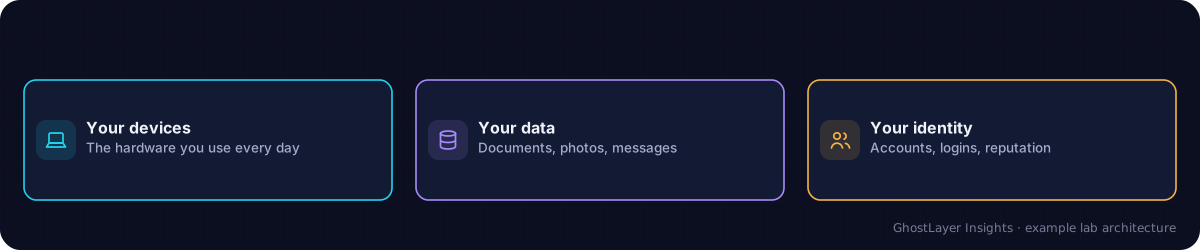
Select any component in the diagram to read what it does.
Text description of this diagram
The three things security protects: your devices, your data, and your identity online.
1. Devices
Laptops, phones, tablets, servers, and even smart home gadgets. These are the machines that store and run everything.
2. Data
The information itself: documents, photos, messages, passwords, bank details, and company records. Data is usually what attackers are really after.
3. Networks
The connections that link devices together — your home Wi-Fi, an office network, and the wider internet. Attackers often travel across networks to reach their target.
4. Identity
Proof of who you are online: your usernames, passwords, and accounts. If someone steals your identity, they can pretend to be you.
Why is it important?
Knowing what you are protecting helps you spot what is most valuable and most at risk. A bank protects data above all; a factory may care most about keeping devices and networks running. The right protection depends on what you have to lose.
A real-world example
Imagine your smartphone. It is a device. It holds your photos and chats (data). It connects to Wi-Fi and mobile networks (networks). And it is logged in to your email and social accounts (identity). A single phone touches all four categories — which is why losing it unprotected is so serious.
Check what you learned
What are the four things cybersecurity protects?
Devices, data, networks, and identity.
Which of the four is usually what attackers are really after?
Data — the information itself, such as passwords, records, and personal details.
Key takeaways
- Cybersecurity protects devices, data, networks, and identity.
- Data is often the real target of an attack.
- What matters most depends on what you have to lose.