
The word “hacker” brings up images of a hooded figure in a dark room. The reality is more interesting — and far more useful to understand.
What is it?
A hacker is simply someone skilled at understanding how computer systems work and finding clever ways to make them do things — sometimes things they were not designed to do. Hacking is a skill. Whether it is good or bad depends on how and why it is used.
Why is it important?
Not all hackers are criminals. Many are defenders who use the same skills to find and fix weaknesses before the bad guys do. Understanding this is the foundation of the next few lessons.
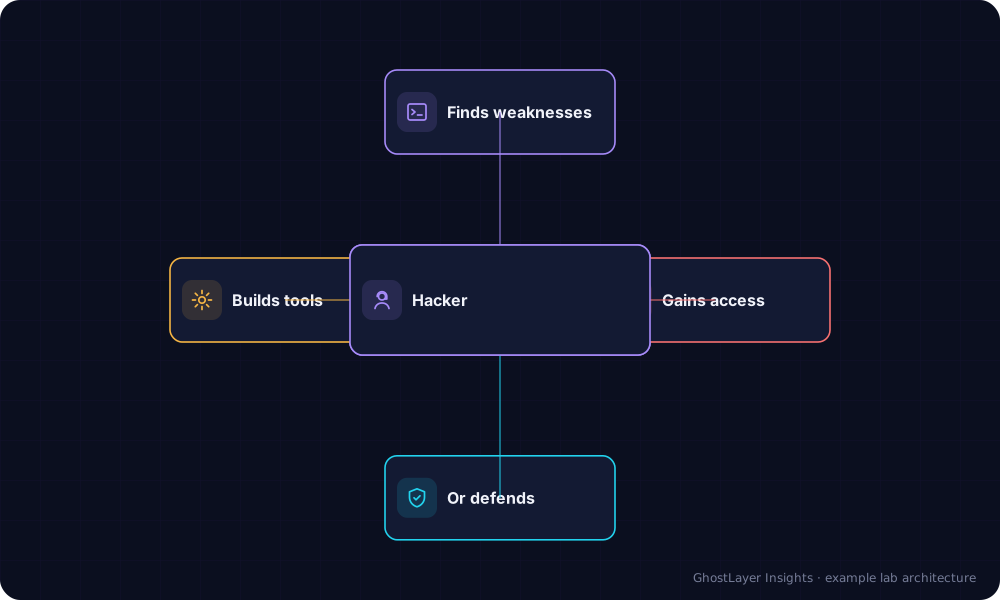
Select any component in the diagram to read what it does.
Text description of this diagram
A hacker is someone skilled at finding and using weaknesses in computer systems — for good or for harm.
How does it work?
A hacker studies a system to answer questions like: What is it supposed to do? What happens if I give it something unexpected? Where are the gaps between how it should work and how it really works? Those gaps are where both attacks and fixes begin.
The security industry hires skilled hackers on purpose. Finding a weakness and reporting it is a respected, well-paid profession.
A real-world example
A security researcher testing a car’s software discovered they could unlock it remotely. Instead of stealing cars, they reported it to the manufacturer, who fixed the flaw and protected millions of drivers. Same skills as a thief — opposite intent.
Check what you learned
Is “hacker” always a negative word?
No. A hacker is someone skilled with systems; whether it is good or bad depends on their intent and permission.
What do defenders and attackers have in common?
They use the same skills and knowledge — the difference is how and why they use them.
Key takeaways
- A hacker is someone skilled at understanding and manipulating systems.
- Hacking is a neutral skill; intent decides if it helps or harms.
- Many hackers are defenders who protect systems for a living.