
Nothing makes the concepts real like actual events. Here are three well-known attacks and what each one teaches us.
Why is it important?
Every major breach teaches a lesson that applies to the rest of us. The causes are rarely exotic — usually a missed update, a weak password, or a convincing email.
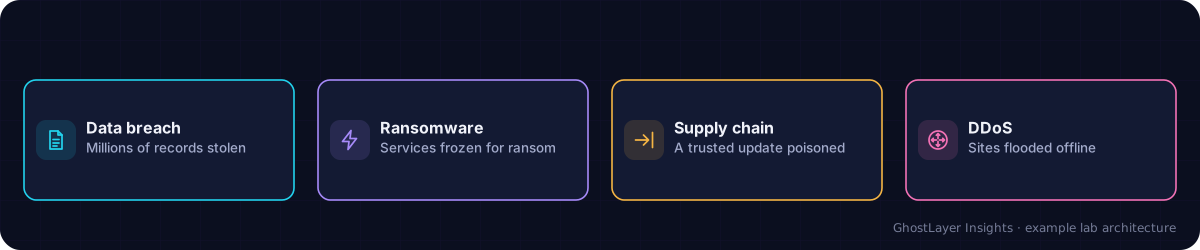
Select any component in the diagram to read what it does.
Text description of this diagram
Famous incidents usually fall into these categories — the same ideas, at large scale.
WannaCry (2017) — the power of updates
Ransomware spread to over 150 countries in days by abusing a Windows weakness. A fix had been released weeks earlier. Lesson: install updates promptly.
The Target breach (2013) — the weakest link
Attackers stole 40 million card numbers by first breaking into a small heating-and-cooling contractor connected to the retailer’s network. Lesson: you are only as strong as your weakest connection.
Colonial Pipeline (2021) — one password
A major fuel pipeline in the US was shut down by ransomware that got in through a single old account with no extra login protection. Lesson: strong passwords and multi-factor authentication matter.
How does it work?
Look closely and you will see the fundamentals from this module in every case: a vulnerability, a motivated attacker, and an impact that could have been reduced. None of these required a Hollywood-style genius — they succeeded because a basic protection was missing.
Check what you learned
What simple step would have prevented much of the WannaCry damage?
Installing the software update that was already available weeks before the attack.
What does the Target breach teach about connected partners?
You are only as secure as your weakest connection — a partner’s weakness can become yours.
Key takeaways
- Most famous breaches came from missed basics, not genius attackers.
- Updates, strong passwords, MFA, and checking your weakest links prevent most harm.
- The fundamentals in this course are exactly what stops real attacks.