
It is the advice everyone ignores — “please install updates” — and yet it prevents some of the biggest attacks in history. Here is why it matters so much.
What is it?
An update (or patch) is a fix released by software makers. As well as new features, updates close security holes — the vulnerabilities from Module 1 that attackers exploit. Patch management is simply the habit of keeping everything up to date.
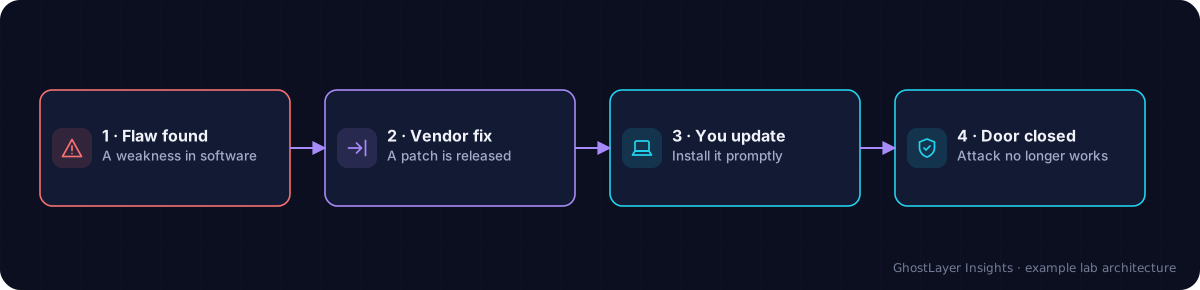
Select any component in the diagram to read what it does.
Text description of this diagram
Updates fix security holes. Installing them quickly closes the doors attackers use.
Why is it important?
When a vulnerability is discovered, the maker releases a patch — but attackers also learn about it and race to exploit everyone who has not updated yet. Every day you delay is a day you are exposed to a weakness that already has a known fix.
How does it work?
- Turn on automatic updates wherever possible — it removes the need to remember.
- Update everything: operating system, apps, browsers, and even smart devices.
- Restart when asked — some patches only take effect after a reboot.
- Replace software that no longer receives updates (“end of life”) — it will never be patched again.
WannaCry (Modules 1 and 2) spread using a weakness that had been patched weeks earlier. Everyone who had updated was safe. It is the clearest proof that updates stop real attacks.
A real-world example
A browser maker announces a serious flaw and releases a fix the same day. Users with automatic updates are protected within hours, without lifting a finger. Users who postpone the update for “later” stay vulnerable to a flaw that attackers are now actively hunting for.
Check what you learned
Besides new features, what do security updates do?
They close security holes (vulnerabilities) that attackers could otherwise exploit.
Why is delaying an update risky?
Once a patch is released, attackers know about the weakness and target everyone who has not yet updated.
Key takeaways
- Updates fix the security holes attackers exploit.
- Turn on automatic updates for everything you can.
- Delaying updates leaves you open to already-known attacks.