
You met this idea briefly in Module 2. Now we give it its proper name and see why it is one of the most important strategies in all of security.
What is it?
Defense in depth means using several independent layers of protection, so that if one fails, others still stand. No single control has to be perfect, because it is never the only thing between an attacker and your data.
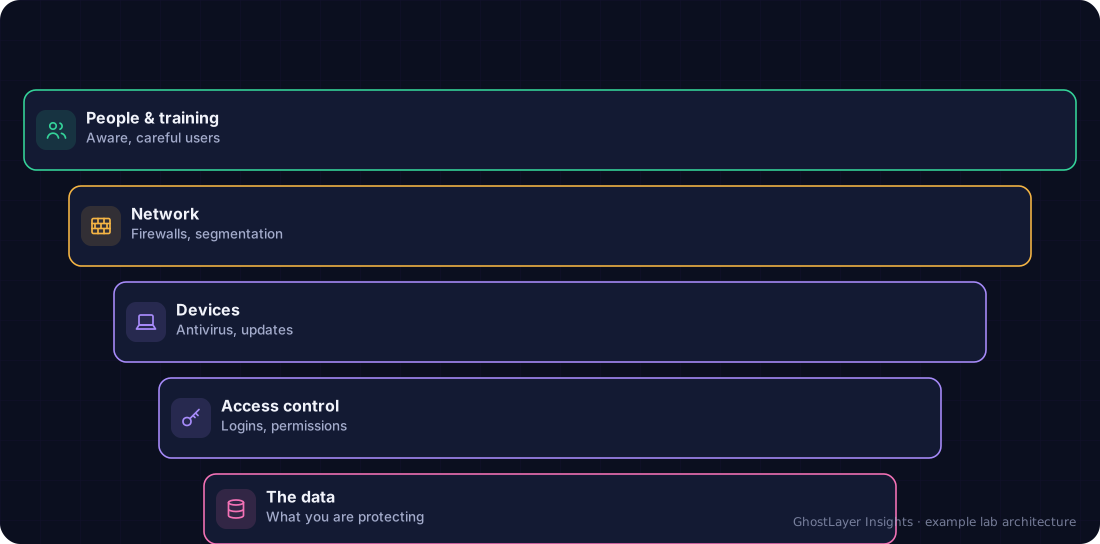
Select any component in the diagram to read what it does.
Text description of this diagram
Security works in layers, so if one fails, others still protect what matters. Each ring is another barrier an attacker must pass.
Why is it important?
Every security control can fail: a password gets stolen, an antivirus misses something, a user clicks a bad link. If you depend on just one, a single failure is a total failure. With layers, an attacker has to defeat all of them — which is far harder.
How does it work?
Think of a castle. It does not rely on one wall; it has a moat, outer walls, inner walls, locked doors, and guards. An attacker who crosses the moat still faces the walls. Digital defences stack the same way:
- A firewall filters traffic at the edge of the network.
- Strong passwords and MFA protect each account.
- Antivirus watches each device.
- Access control limits what a breached account can reach.
- Backups let you recover if everything else fails.
The analogy to an onion is common: an attacker has to peel through layer after layer, and each one is a chance to stop or slow them.
A real-world example
An employee clicks a phishing link and enters their password — layer one has failed. But because the company also uses multi-factor authentication, the attacker is blocked at the login code. One layer failed; the next one held. That is defence in depth working exactly as intended.
Check what you learned
What does defense in depth mean?
Using several independent layers of protection, so that if one fails, others still protect you.
Why not rely on a single strong control?
Because any single control can fail; one failure would then be a total failure. Layers mean an attacker must defeat them all.
Key takeaways
- Defense in depth stacks multiple independent layers of protection.
- If one layer fails, the others still stand.
- It is the reason a single mistake rarely leads to a full breach.