
Detection & Prevention
No single control stops every attack. Strong security stacks several layers so that if one fails, another still protects what matters. This is “defence in depth”.
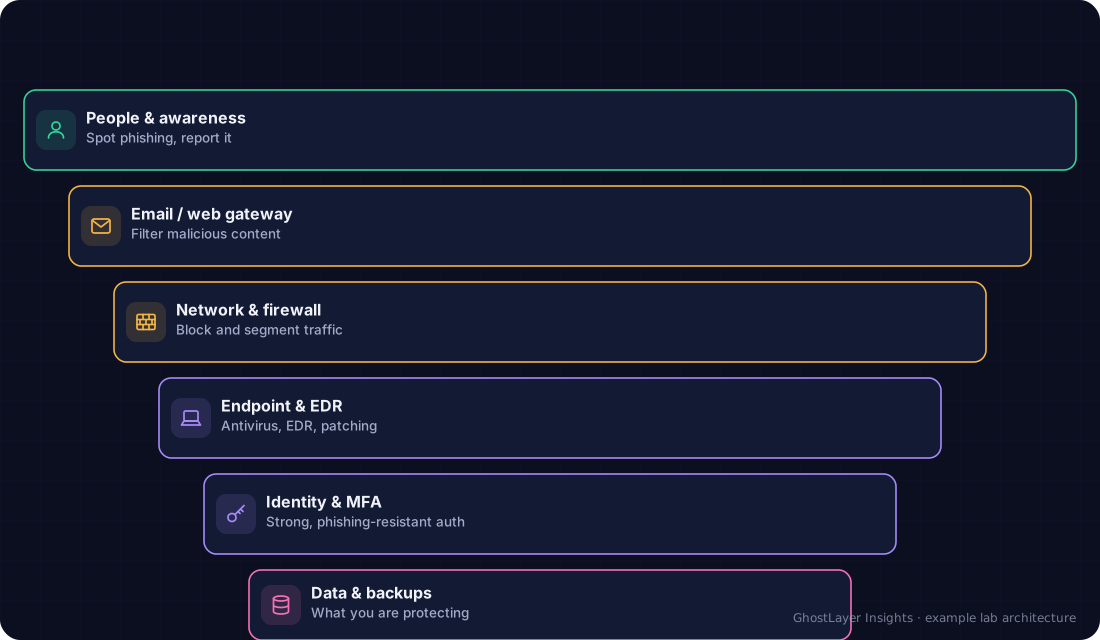
Select any component in the diagram to read what it does.
Text description of this diagram
No single control stops every attack. Layered defences mean that if one fails, another still protects the data.
Each layer below is matched to a stage of the attack lifecycle. Together they make an attacker’s job hard, slow, and noisy — and most attackers move on to an easier target.
The key controls
- People & awareness — training and a “report phishing” button stop many attacks at the very first step.
- Email & web filtering — SPF, DKIM, DMARC and gateway filtering block malicious messages and sites.
- Multi-factor authentication — phishing-resistant MFA means a stolen password alone is not enough.
- Patching — keeping software updated closes the known holes attackers rely on.
- Endpoint protection & EDR — antivirus and behaviour-based detection catch and contain malware.
- Least privilege & segmentation — limit what any one account or machine can reach, so a breach can’t spread far.
- Logging, monitoring & SIEM — collect and watch logs so suspicious activity raises an alert quickly.
- Backups — tested, offline backups are the ultimate answer to ransomware: if you can restore, you never pay.
Detect early, contain fast
Prevention is not perfect, so detection matters too. The sooner suspicious activity is spotted — a burst of failed logins, a process encrypting files, an unusual database query — the faster the security team can isolate the affected systems and recover. Early detection turns a potential disaster into a minor incident.